Admissions systems grow with every intake cycle. New prospects enter the funnel, applicants move through evaluation stages, students enroll, and alumni records accumulate over time. Growth is a healthy sign of recruitment activity but without a structured approach, the database can gradually get messy.
A sustainable data cleanup strategy ensures that your admissions system remains relevant, accurate, and aligned with institutional goals. Data cleanup is not about deleting records randomly. It is about defining clear policies for how data is managed, when it should be reviewed, and how long it should remain active.
When data cleanup is treated as an ongoing governance discipline rather than a one-time project, the admissions system remains structured and actionable over the long term.
How to Start Your Data Cleanup: Different Data, Different Rules
Data cleanup in an admissions system cannot be approached with a single rule applied across the entire database. Different types of records serve different purposes, and each requires its own review logic.
Prospect data, applicant records, student histories, and alumni information each serve different purposes and require different review policies.
A sustainable data cleanup strategy begins by defining category-based rules. By distinguishing between these data types, institutions can ensure that records are reviewed, archived, deleted, or in some cases, intentionally left unchanged.
Data cleanup is not always about deletion. Sometimes the more important decision is whether a category of data requires active cleanup at all, or whether it should simply remain untouched.
The following sections outline how data cleanup policies can vary across prospects, applicants, students, and alumni.

Prospect Data Cleanup: Managing Validity and Engagement
Prospect data is often time-sensitive. Interest is typically tied to a specific intake or recruitment period. A sustainable data cleanup strategy should define how long prospect records remain valid within the admissions system.
Intake-Based Validity Windows
Universities may choose to define a validity period for prospect records, such as:
One admissions cycle
One academic year
A defined number of months after initial inquiry
However, the end of a validity window should not automatically trigger deletion. Before reclassifying or archiving prospect records, universities may implement structured re-engagement efforts.
This could include:
A final campaign inviting prospects to apply for the upcoming intake
A targeted reminder sequence
A “last touch” communication confirming continued interest
Only after these efforts should a review decision be made. Some prospects may convert to a new intake. Others may move into an archived or inactive category.
Defining intake-based validity, combined with structured re-engagement, ensures that data cleanup remains strategic rather than reactive. It prevents outdated records from distorting reporting while still allowing room for renewed interest.
Engagement-Based Review Criteria
Engagement signals can also guide data cleanup decisions. For example:
- Hasn’t opened or clicked recent emails
- Didn’t start an application after reminders
- Hasn’t responded after several outreach attempts
Engagement-based criteria allow universities to distinguish between inactive prospects and those who remain genuinely interested. This ensures that active recruitment efforts remain focused and measurable.
Prospect data cleanup should be based on clear rules rather than assumption.
Applicant Data Cleanup: Structuring Inactive and Incomplete Applications
Not all applicants complete the admissions process. Some begin applications but never submit. Others defer, withdraw, or remain in intermediate statuses.
A sustainable data cleanup strategy should define how these records are handled after each intake cycle.
Post-Intake Evaluation
After an admissions cycle concludes, institutions may:
Reclassify incomplete applications
Define a limited re-engagement window
Archive or mark inactive those applications that remain unsubmitted
Defining Clear Review Outcomes
If re-engagement efforts do not result in activity, the admissions system should then apply defined rules. Incomplete or inactive applications may be:
Reclassified under a closed or inactive status
Archived to preserve historical reporting
Removed, if institutional policy supports deletion after a defined period
Applying defined review rules allows admissions teams to maintain reporting accuracy while preserving historical integrity where needed.

Student and Alumni Data Cleanup: Retention with Accuracy
Student and alumni records typically require long-term retention. Academic history and alumni engagement are core institutional assets. However, data cleanup can still play a role.
Ensuring Accurate Lifecycle Conversion
Data cleanup includes confirming that lifecycle transitions occur properly:
Prospect → Applicant → Student → Alumni
A sustainable approach ensures:
No duplicate records created during conversion
No outdated lifecycle stages left active
Proper continuity of record history
Accurate conversion protects reporting integrity and maintains a clean lifecycle structure.
Maintaining Long-Term Record Integrity
Retention should not mean allowing structural inconsistencies to persist. Institutions should periodically review:
Duplicate student records
Outdated field values
Inconsistent lifecycle labels
Long-term data requires ongoing structure.
Designing a Practical Data Cleanup Framework
A clear framework ensures that data cleanup decisions are policy-driven rather than ad hoc.
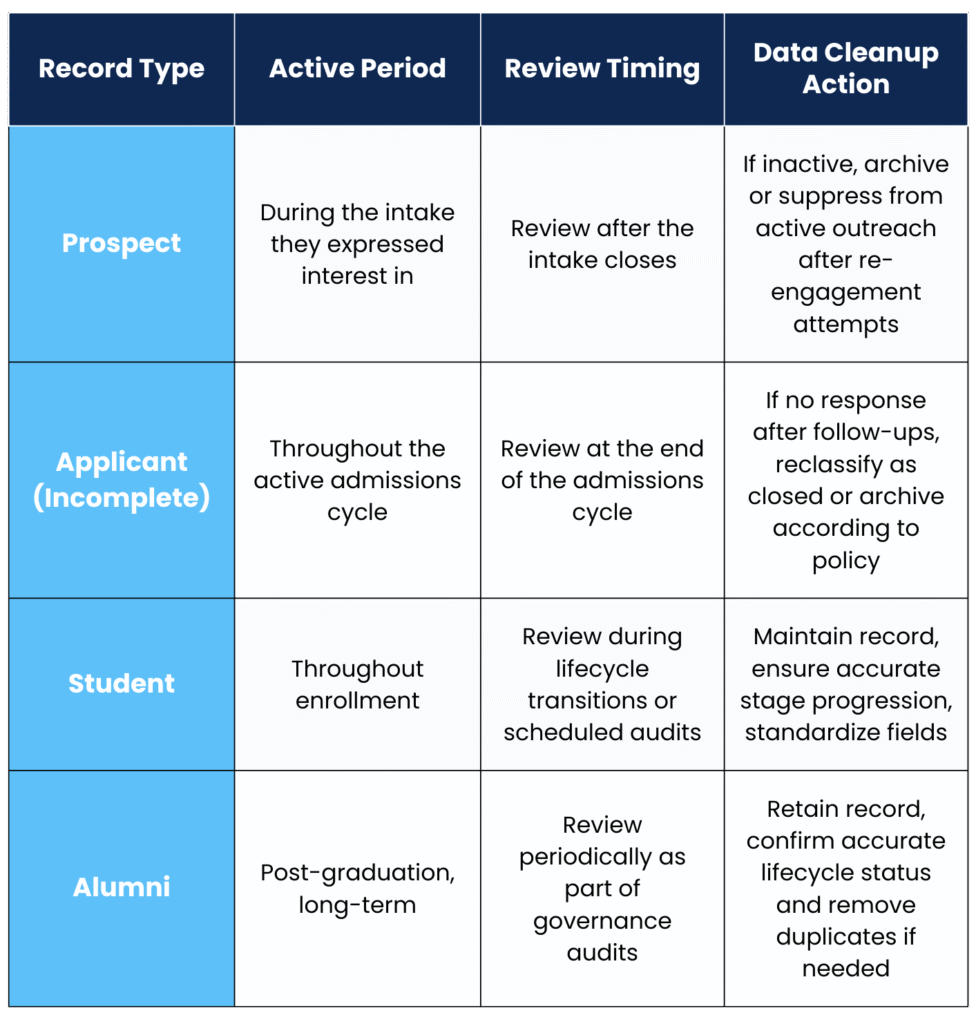
This type of framework clarifies expectations and supports consistent execution across admissions teams. However, such guidelines may vary depending on the university’s structure, compliance obligations, and admissions strategy.
Embedding Data Cleanup Into Admissions Operations
For data cleanup to remain sustainable, it should be embedded into routine operations rather than treated as a periodic emergency task.
Institutions may choose to:
Conduct reviews at the end of each intake
Schedule annual database audits
Automate suppression and archiving rules where appropriate
Assign clear ownership for data governance
When data cleanup becomes part of operational discipline, the admissions system remains aligned with institutional priorities.
A structured data cleanup strategy supports clearer reporting, more accurate conversion tracking, and more focused recruitment efforts. Managing prospect validity, applicant inactivity, lifecycle transitions, and field standardization within defined policies ensures that your admissions system remains relevant and actionable.