Educational institutions generate and manage a significant volume of student data every day. From the first inquiry through enrollment, academic progress, and eventually alumni engagement, information is continuously created, updated, and shared across departments.
At first, this usually feels manageable. Each team has its own system. Admissions works in one platform, academics in another, finance in another. Over time, however, these systems begin to operate independently rather than collaboratively.
The complexity arises not from the existence of these systems, but from the lack of coordination between them. Learning how to manage student information across systems requires more than implementing technology. It requires alignment, structure, and ongoing oversight.
Without that alignment, small inconsistencies gradually turn into larger operational issues. Reports stop matching. Teams lose confidence in the data. Decision-making becomes slower and more cautious.
Managing student information effectively is therefore not simply a technical matter. It is an institutional priority.
Why It Can Be Difficult to Manage Student Data Today
Over the past decade, institutions have invested heavily in digital transformation. New systems are introduced to improve recruitment, streamline enrollment, enhance learning delivery, or strengthen reporting capabilities. Each implementation typically addresses a specific challenge at a specific point in time.
The challenge is that these systems are not always aligned within a single, unified data strategy. Admissions, academics, marketing, and finance may each manage student data within their own platforms and processes. While these approaches function well at the departmental level, they often make it difficult to see the full student journey in one place.
Before exploring solutions, it’s important to understand the systems involved.
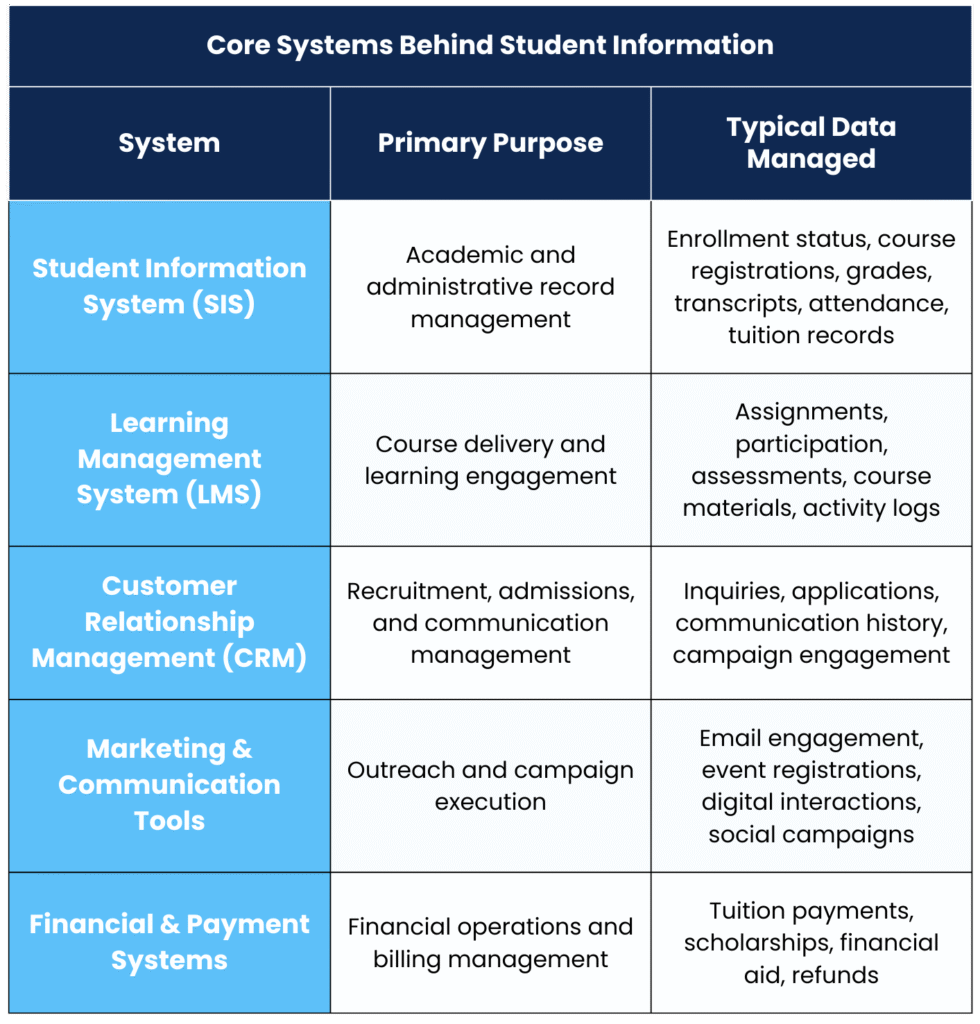
The Core Systems Behind Student Information
To understand how to manage student data properly, it helps to clarify where that information actually resides.

Student Information Systems (SIS)
The Student Information System, often referred to as the SIS, serves as the administrative and academic record system.
It typically manages enrollment records, course registrations, grades, transcripts, attendance, and tuition data. Because it holds official academic records, it is often considered the authoritative source for structured student data.
While they are strong in academic record-keeping and administrative processes, they often have limited capabilities when it comes to managing the earlier stages of the student journey, such as prospect tracking, application nurturing, or recruitment communication.
Learning Management Systems (LMS)
The Learning Management System focuses on the learning experience itself.
It manages course materials, assignment submissions, discussion forums, assessments, and student participation in online or blended environments. As a result, the LMS generates detailed engagement data that can provide meaningful insight into how students are progressing throughout their courses.
In many institutions, this information is primarily used at the faculty or course level. However, when institutions want to take a deeper look at student success trends, engagement patterns, or progression across programs, connecting LMS data with other reporting systems can be useful.
Customer Relationship Management (CRM)
A CRM system is commonly used to manage recruitment, admissions communication, and sometimes retention initiatives.
It helps institutions track prospective student inquiries, monitor application progress, record communication history, and manage outreach campaigns. CRMs are particularly effective at organizing large volumes of interactions and supporting structured follow-up throughout the admissions cycle.
In some institutions, the CRM may also support retention initiatives or alumni engagement, depending on how it is configured and used.
Marketing and Communication Tools
In addition to CRMs, many institutions rely on dedicated marketing or communication platforms.
These tools are used to manage email campaigns, event registrations, social media outreach, landing pages, and digital advertising. They often collect valuable data about student interests, engagement behavior, and campaign performance.
While these systems are focused on outreach rather than academic records, they still contribute important pieces to the overall student data landscape.
Financial and Payment Systems
Financial platforms handle tuition payments, scholarships, financial aid processing, refunds, and billing cycles. They contain essential student information related to financial status and account history.
Where Complexity Emerges
Each of these systems serves a legitimate and necessary purpose within the institution. Complexity does not arise simply because multiple systems exist, but because they are often managed separately without a consistent, shared view of student status.
If one system reflects a student as active while another lists them as deferred, internal teams may make conflicting decisions. If engagement data remains siloed, opportunities for early intervention may be missed.
Managing student information effectively requires more than maintaining individual systems. It requires clear processes to ensure that records remain up to date and aligned across platforms, so that all departments operate with the same understanding of the student journey.
A Practical Approach to Managing Student Information Across Systems
Improving how institutions manage student data does not mean integrating every system completely or duplicating all information across platforms. In many cases, trying to connect everything at once introduces unnecessary complexity and creates more maintenance work over time.
A more sustainable approach is to focus on alignment around the data points that truly matter.

Start With the Source of Truth
Every critical data element should have a clearly defined source of truth.
For example:
If the Student Information System (SIS) is the authoritative source for enrollment status, that status must be reflected accurately in systems that depend on it.
If the finance system confirms tuition payments, that update should be visible wherever payment status influences communication or access.
The goal is not to copy all data everywhere, but to ensure that the most important statuses remain consistent across platforms.
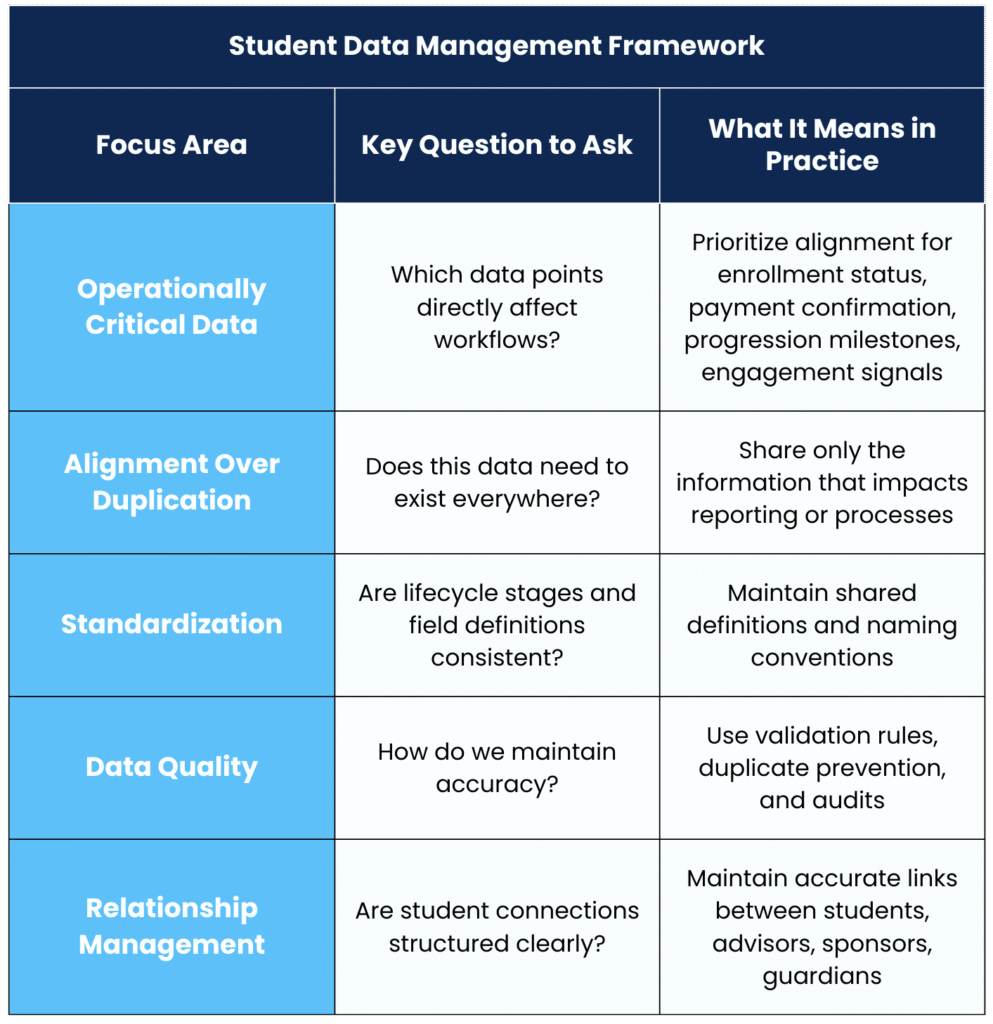
Prioritize Operationally Critical Data
Not all data requires synchronization. Institutions should identify which information directly influences decision-making and workflows.
This often includes:
Enrollment status;
Payment confirmation;
Progression milestones;
Engagement or campaign activity;
Withdrawal or deferment status.
By prioritizing these data points, institutions reduce noise while protecting what truly drives operations.
Focus on Alignment, Not Duplication
Managing student information effectively is not about centralizing every field into one master system. It is about defining:
Which system owns each critical data point;
Where that data needs to be reflected;
When updates should be synchronized;
How ongoing alignment will be maintained.
When institutions focus on keeping essential data aligned rather than moving everything everywhere, coordination becomes manageable and sustainable.
Managing student data across systems ultimately comes down to prioritization. Not every field needs to travel between platforms, but the information that shapes enrollment, finance, engagement, and progression must remain consistent wherever it influences institutional processes.
Key Areas That Support Student Data Management
Beyond system alignment, a few core practices help institutions manage student information more effectively over time.
- Standardization as a Long-Term Discipline: Even when systems are aligned, inconsistencies can emerge if departments interpret fields or lifecycle stages differently. Shared definitions, naming conventions, and update policies help prevent complexity from increasing as the institution grows.
- Data Quality as an Ongoing Practice: Data cleanup should not be treated as a one-time initiative. Ongoing validation rules, duplicate prevention, and periodic audits are necessary to ensure that student records remain accurate over time.
- Managing Complex Student Relationships: Student data includes connections to advisors, faculty, sponsors, and sometimes guardians. Maintaining clear relationship structures ensures that communication, reporting, and compliance remain accurate and contextual.
A Connected Data Management Ecosystem with Eduhub
Eduhub provides a fully developed student data and admissions ecosystem designed to bring inquiries, applications, communication, and key student touchpoints into one connected environment. Our solutions centralize and structure the admissions journey while ensuring that critical data — such as enrollment status, payments, and engagement activity — remains clear and consistent.
Where necessary, we integrate with existing systems to keep essential information aligned, without introducing unnecessary complexity. The result is a streamlined, coordinated student journey supported by a single, reliable platform.
If you’re looking to simplify how your institution manages student information across systems, explore Eduhub’s solutions and see how a connected ecosystem can transform your admissions and data processes.
Frequently Asked Questions on Student Data Management
What does it mean to manage student data across systems?
It means keeping important student information aligned and up to date across platforms such as SIS, CRM, LMS, finance, and marketing tools so all departments operate from the same understanding.
What systems typically store student data?
Student data is usually stored across Student Information Systems (SIS), Learning Management Systems (LMS), CRMs, financial systems, and marketing or communication tools.
Do institutions need to integrate all their systems?
No. The goal is not full duplication, but aligning the critical data points that influence enrollment, payments, engagement, and reporting.
What are common patterns that lead to data chaos?
Common causes include unclear ownership of updates, inconsistent lifecycle definitions, poor data quality practices, and systems that are not kept aligned over time.
How can institutions improve student data management?
By defining clear sources of truth, prioritizing critical data points, and establishing ongoing standards for data quality and alignment.