Higher education institutions do not manage a single type of contact. They manage an ecosystem of people and entities connected through different roles, stages, and processes. An admissions system typically handles far more than just applicants. It includes prospects, students, parents or guardians, recruiters, partner schools, agencies, and internal staff.
Each of these entities plays a distinct role within the admissions journey and interacts with the system in different ways.
When the structure behind these records is designed intentionally, the admissions system remains clear and scalable. When it is not, complexity tends to accumulate beneath workflows and reporting processes.
Understanding this underlying architecture is essential for institutions that want their admissions system to remain reliable as processes evolve and data volumes grow.
Understanding Common Contact Types in a Higher Ed Ecosystem
An admissions system does not only store “student” data. It typically manages a range of individuals and organizations involved in the recruitment and enrollment journey.
These often include:
Prospect
Applicant
Student
Alumni
Parent or Legal Guardian
Recruiter
Counselor
Agency
High School
University or Institutional Partner
These records may all exist within the same admissions system, but they serve different structural purposes. Some represent lifecycle stages, others define relational roles, and some represent partner institutions or external entities.
When these distinctions are not clearly reflected in the data model, reporting, segmentation, and communication logic can become harder to manage.
Differentiating Lifecycle Stages and Contact Types
Within an admissions system, the records introduced earlier may exist together, but they do not function in the same way. Some are designed to evolve over time, while others exist to preserve relational context.
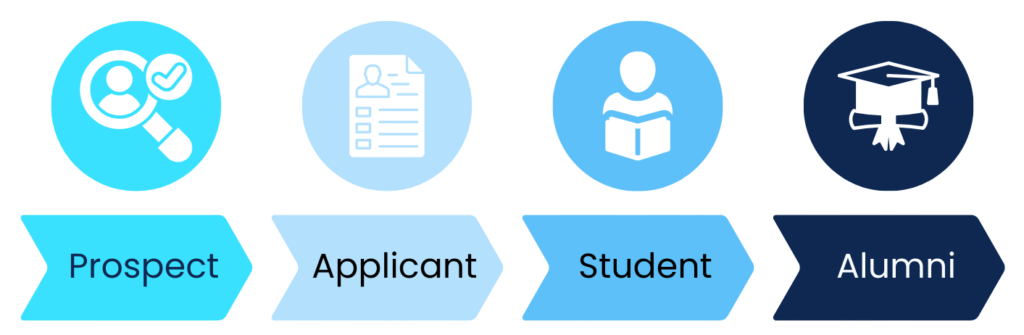
Lifecycle-Based Contact Types
Certain contact types represent progression through the admissions and institutional journey. These include:
Prospect
Applicant
Student
Alumni
These records are expected to convert as an individual moves forward. A prospect may submit an application and become an applicant. An applicant may enroll and become a student. Over time, a student may transition to alumni.
In this case, the contact type reflects movement through defined lifecycle stages.
Relational Contact Types
Other contact types define how individuals or organizations are connected to the primary person in the system. Examples include:
Parent or Legal Guardian
Recruiter
Counselor
Agency
High School or Institutional Partner
These records typically remain stable. They do not convert from one stage to another, but instead maintain the relational structure around the student or applicant.
An admissions system must support both dynamics: structured lifecycle conversion and stable relationship mapping. When these behaviors are not clearly distinguished in the data model, lifecycle tracking and communication logic can become harder to interpret.
Designing the system with this separation in mind allows institutions to manage progression and relationships without blurring their structural purpose.
Admissions Data Extends Beyond Contact Records
Architecture in admissions systems is not limited to contact records. Additional objects often play an equally important role.
For example, institutions may manage:
Application records
Campaign participation
Event registrations
Academic programs
A single student may submit multiple applications across terms or programs. That history cannot be accurately represented if application information is simply stored as additional fields on a contact profile. Likewise, campaign engagement or recruitment events are better structured as related records rather than static attributes.
Separating these elements into their own objects creates cleaner profiles, clearer reporting, and more accurate historical tracking.
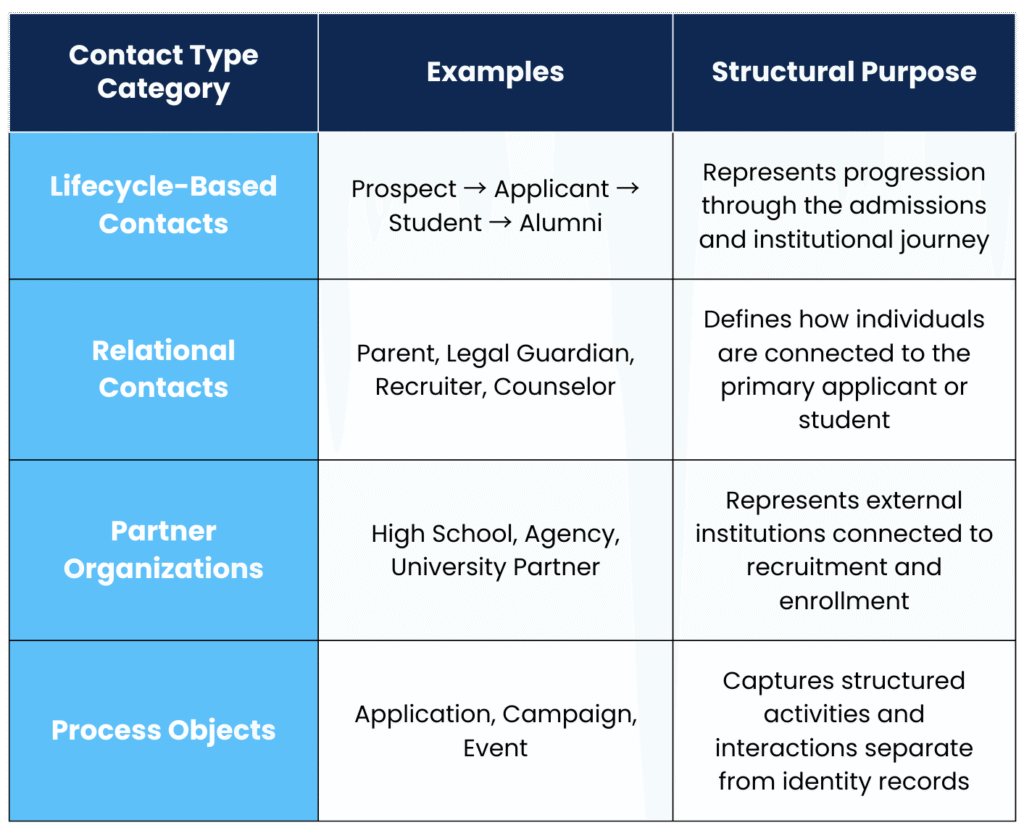
Admissions System Architecture: How These Elements Work Together
The following table illustrates how different elements of admissions data can function within a structured system.
Why Salesforce Is Ideal for Structuring an Admissions System
Designing a structured admissions system requires a platform that can handle layered relationships, evolving lifecycle stages, and multiple related processes. Salesforce is built for this level of structural complexity, with an object-based and highly configurable architecture.
Unlike systems that rely on fixed templates, Salesforce provides the flexibility to design an admissions system that reflects how institutions actually operate. This is especially important in higher education, where the student journey is rarely linear and relationships often extend beyond a single individual.
Because of its flexible data model and relationship framework, Salesforce enables institutions to maintain structural clarity while supporting precise communication and reliable reporting as the admissions system grows.

Eduhub: Built on Salesforce for the Full Admissions Workflow
Eduhub is built on Salesforce and designed specifically to support the entire admissions workflow from initial inquiry through enrollment and beyond.
Because it leverages Salesforce’s flexible architecture, Eduhub provides a structured admissions system that handles lifecycle progression, contact types, related objects, and relationship mapping within one connected environment. Applications, campaigns, communication touchpoints, and enrollment processes are modeled intentionally rather than layered on top of one another.
This foundation allows institutions to manage prospects, applicants, students, partners, and related organizations within a single structured ecosystem. Where necessary, integrations extend the system further, but the core admissions workflow remains centralized and architecturally sound.
By combining Salesforce’s powerful data model with a purpose-built admissions solution, Eduhub delivers both structural clarity and operational control across the entire admissions journey.
If you’d like to explore how this structure translates into practice, you can learn more about Eduhub’s admissions solutions here.